

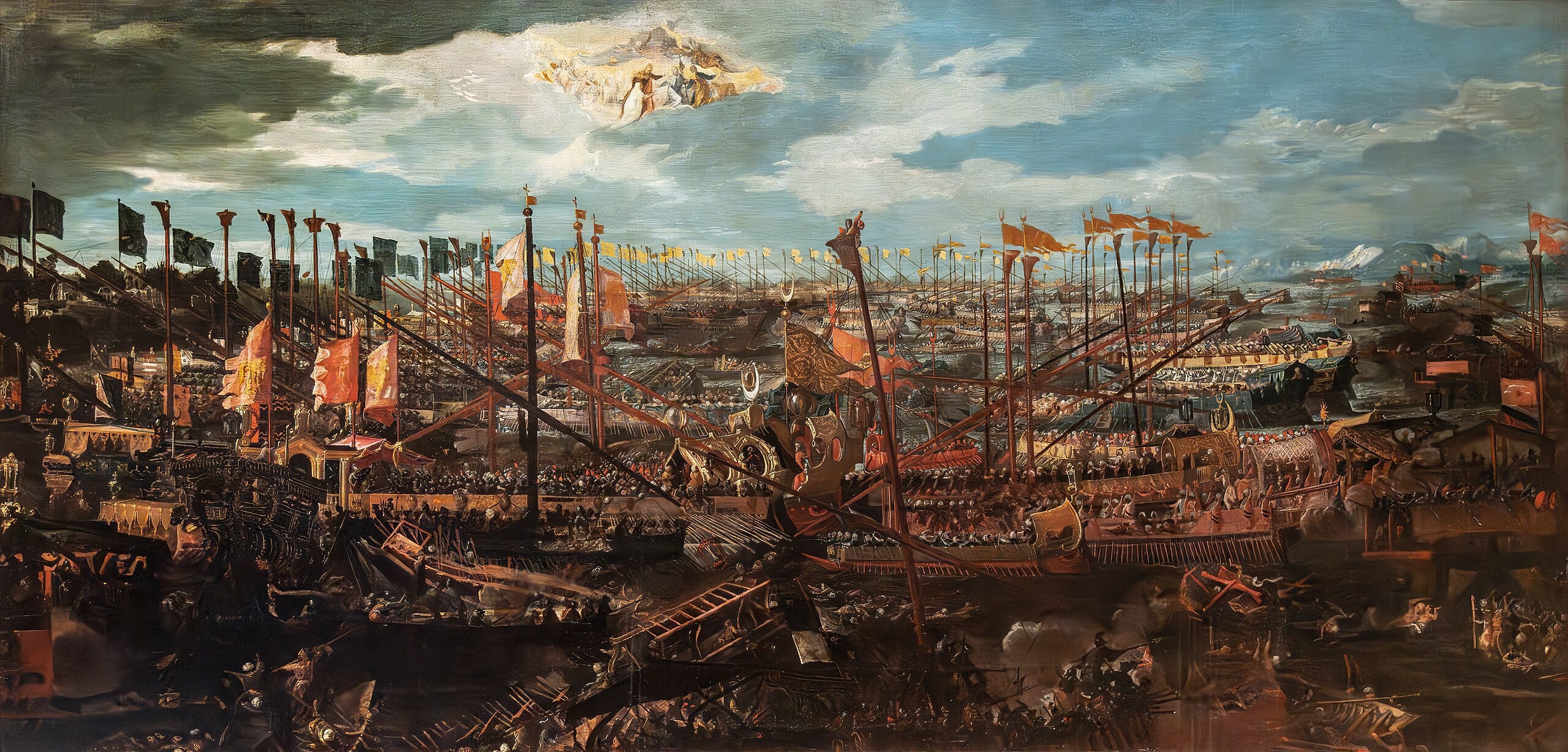
Eleven draining months the siege weighs upon the fortress city of Famagusta on Cyprus. The banner of the Winged Lion of St Mark hangs in red fringes over the battlements. Since September 1570 the Ottomans have been besieging the last city remaining from Venetian rule on Cyprus. In the midst of peace the Turks had attacked the largest Venetian colony in the Mediterranean; the capital Nicosia fell prey to plunder and destruction. Twenty thousand people are said to have lost their lives in the Turkish bloodlust. One reason why many of the Venetian fortresses, which were among the largest and most modern in the Mediterranean region, opened their doors to the invaders. No one wants to risk a second massacre.
Only Famagusta holds out. Marcantonio Bragadin, the fortress commander, is already regarded as a hero in the Occident. His 8,000 men have already repelled five Ottoman assault attempts. Only a few years after the siege of Malta, it is again a massively superior Ottoman force that rebounds from a Christian bastion. Famagusta possesses a protected harbour, Venetian ships supply the city for months. And there is hope: for the Doge is in negotiations with the Pope, who wants to bring a Holy League into being. The greatest fleet Christendom has ever seen is to save Famagusta and Cyprus. The Arsenal in Venice, which with its prefabricated ship modules can assemble and launch galleys at a daily rate, has been working incessantly for months. And according to rumours, Spain is to join the alliance—together with its legendary Armada, which has already taught the corsairs of the Barbary Coast in North Africa to fear.
But unlike Malta, Famagusta awaits no happy ending. In August 1571 the besieged run out of ammunition. The Ottomans have driven underground tunnels into the earth and are destroying the foundations of the fortress walls. The Turkish cannons fire new salvoes ceaselessly and put Bragadin under pressure. The Venetian commander faces a decision: hold out, and sacrifice the lives of his men who have defended themselves so bitterly; or offer capitulation and ask for safe conduct. Bragadin decides upon the latter. For the conditions appear favourable: the Ottoman general Lala Kara Mustafa Pasha has already lost over 30,000 soldiers at the walls, and appears ready to negotiate. The Turks make a generous offer: Bragadin and his men may withdraw with their standard held high.
Broken Promises
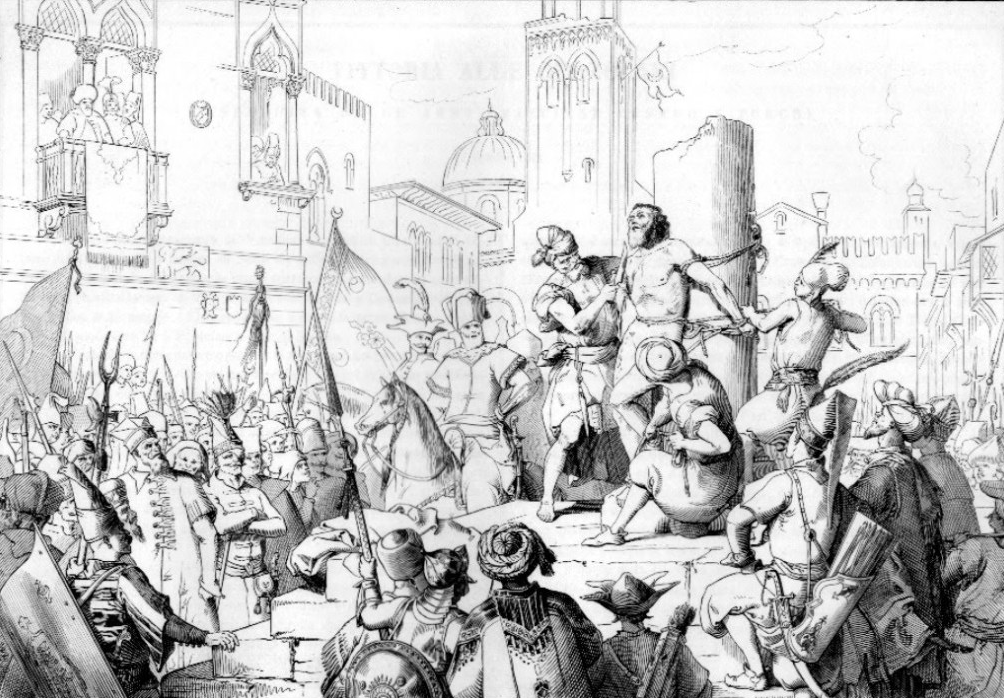
But for the Venetian there is a rude awakening. Scarcely do the Turks occupy the positions when the promises are null and void. At the handover ceremony Mustafa draws his dagger, attacks Bragadin and cuts off one ear—and orders his soldiers to cut off his other ear and nose as well. The Ottomans thereupon kill Governor Baglioni, and begin the massacre of the Christian population.
Bragadin is paraded before the victorious Ottoman troops. For thirteen days he is tortured in the dungeon of his own fortress. His tormentors offer him conversion to Islam to end the torment, but the Venetian resists again and again. They burden him with stones and drag him thus around the city walls of Famagusta. Two weeks after the fall of the city they have him flayed alive and quartered before a jeering audience. Even after his martyrdom they make sport of him, stuffing his skin with straw, dressing him in a uniform and placing the macabrely disfigured corpse on an ox that is paraded through the streets. In the end the mortal remains are distributed as trophy pieces amongst the soldiers, Bragadin’s skin goes to the Sultan of Constantinople.
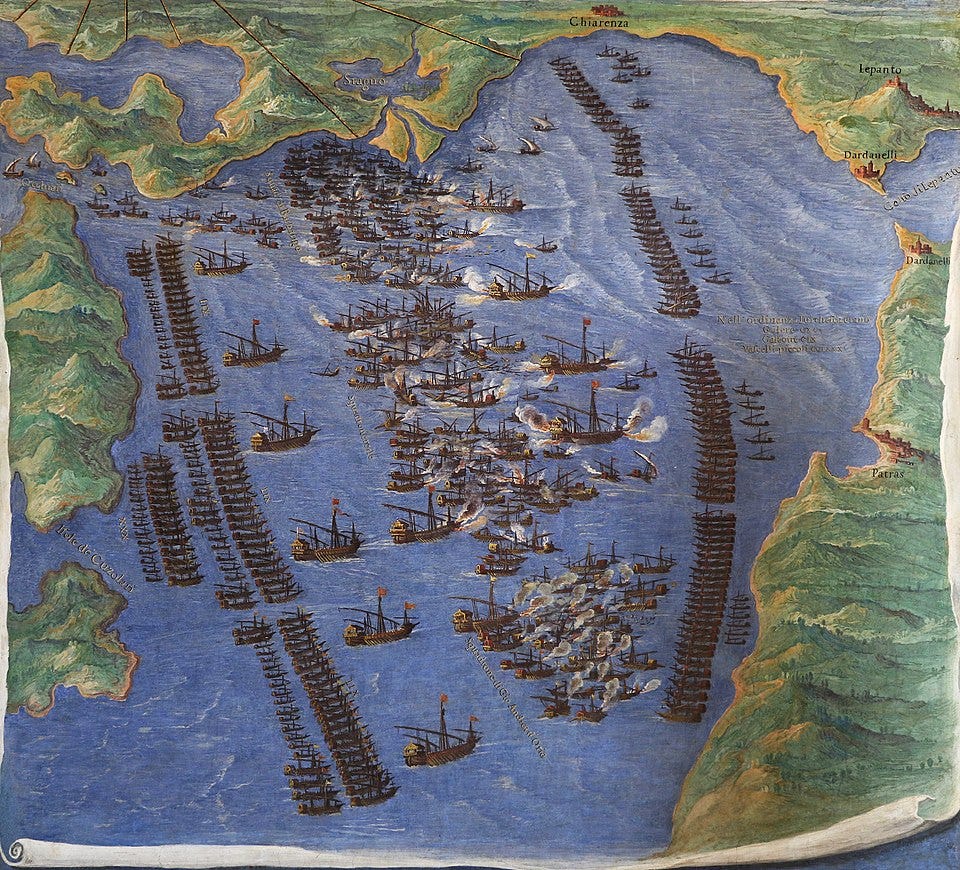
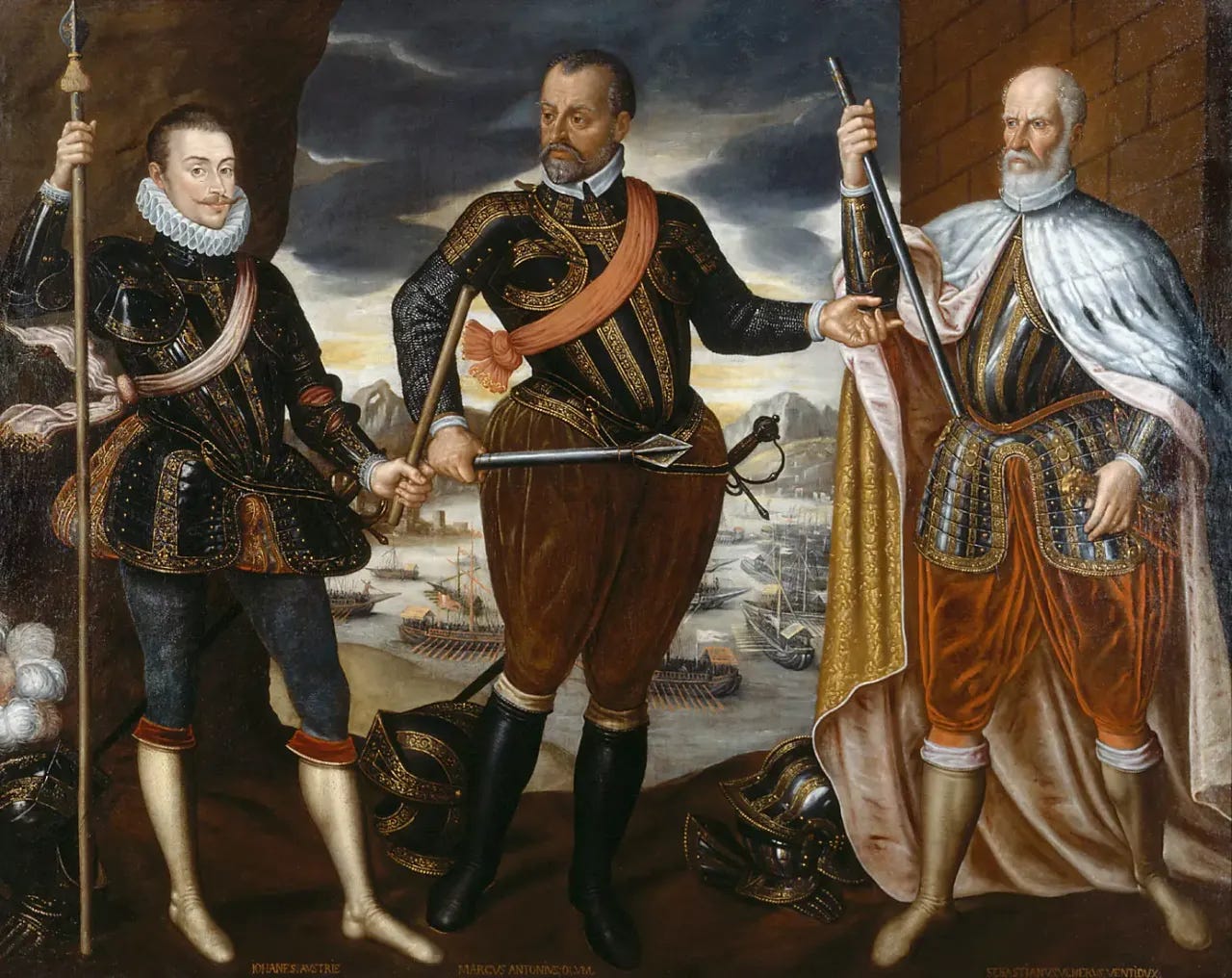
These horror stories do not remain hidden from the Christian powers. Finally the League comes together—too late for Cyprus, too late for Famagusta and too late for Bragadin. In Messina comes the rendezvous of the sea powers, led by Spain, Venice and the Papal States. Supreme commander of the fleet is Don Juan de Austria, the Spanish fleet leader—an illegitimate son of Emperor Charles V, only 24 years old. His flanks are protected by the Venetian Captain-General Sebastiano Venier and the Roman Marcantonio Colonna. Besides these three main powers, the Republic of Genoa, the Grand Duchy of Tuscany, the Duchy of Savoy, the Duchy of Urbino and the Order of Malta participate with their naval squadrons; further Italian states, such as the small Republic of Lucca, are not present with ships but support the League’s cause financially with material and men. Although the Holy Roman Empire is not officially a combatant, German soldiers are also present on the ships of the Holy League.
Assembling the Armada
The latter are also urgently necessary. The League has 212 ships, of which 115 alone fall to Venice (for comparison: Spain sent 49, Genoa 27 and the Pope 7 ships). The Venetian shipyard worked at full capacity, but the Republic does not have enough men to crew all the galleys with soldiers. It is therefore particularly men from the parts of the Spanish-Austrian empire who complete the crews even amongst the Venetians. Besides the 40,000 seamen, therefore, more than 28,000 additional soldiers in Habsburg pay reinforce the League. Whilst most rowers are prisoners, amongst the Venetians there are also free citizens defending themselves. The Christian host thus comprises nearly 70,000 men—a dizzying number that is scarcely reached in land battles.
The Christian secret weapon, however, is six Venetian ships that eclipse all other galleys in their dimensions. These galleasses appear to friend and foe alike as floating wooden monsters. Over five hundred rowers propel each of these giant galleys. Their overwhelming firepower is superior to any other ship. The deadliest trick: the galleass can fire in any direction with its bow and stern cannons.
On 7 October the Christians meet the Muslim fleet at Lepanto. Before the combat operations the 70,000 rowers and soldiers pray. In the cities of Christendom they pray the rosary at the same time to ask the Mother of God Mary for victory. Pope Pius V had for this purpose blessed the standard with the crucifix and Saints Peter and Paul, on which the old motto “In Hoc Signo Vinces” was embroidered. On the League’s flagship, the “Real” of Don Juan de Austria, the Mother of God was also displayed with the inscription “S. Maria succurre miseris”. The commander, by contrast, makes do with great speeches and laconically reminds his crew that paradise was not made for cowards.
The Battle
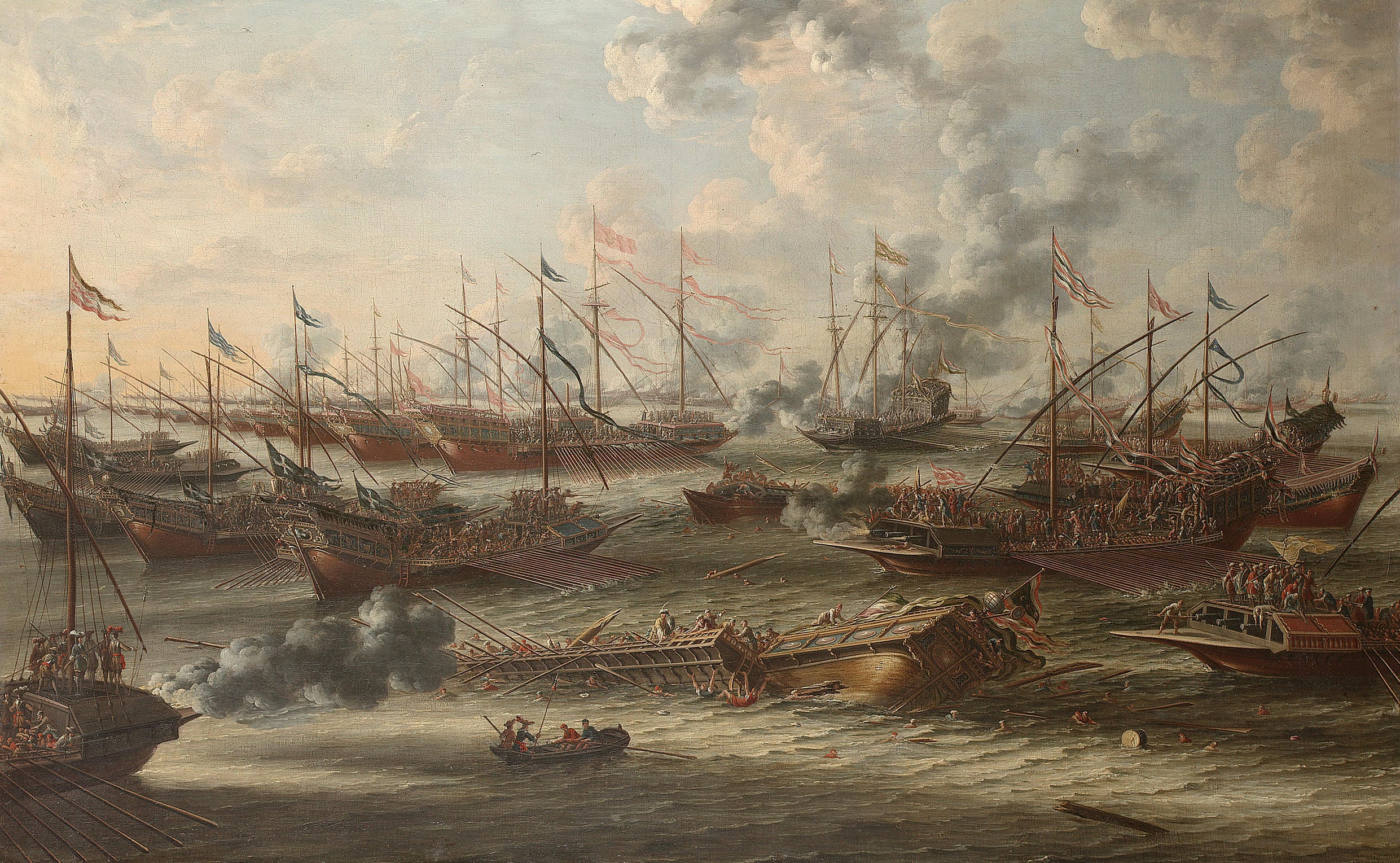
The 212 ships face a wall of sails, oars and green banners; the entire horizon is occupied by the Turkish armada. In material and manpower the Ottomans are superior: the enemy navy amounts to over 250 ships and comprises at least 10,000 more men. But Sufi Ali Pasha, who already believes in victory, does not reckon with the destructive power of the galleasses, which sail ahead of the Christian fleet, and with their all-round fire strike breaches in the Ottoman forest of masts. The elevated railing first makes it impossible for the Turks to board these at all. The deployment of Don Juan de Austria, who seeks personal confrontation on his flagship, also comes unprepared for the Turks; and finally it is the Ottoman archers who draw the short straw in the face of the Spanish arquebuses and muskets. The superior firepower of the Christians compensates for the quantitative superiority of the Ottomans.
Lepanto enters history not only as the greatest galley battle in human history. It is a test of man and material such as world history seldom knows. Over one hundred thousand people are embroiled in the sea of blood. On the Christian as well as the Muslim side, veterans from decades-long conflicts between the sea powers on both sides of the Mediterranean coast fight. Miguel Cervantes, the famous Spanish poet who will later gain world fame with his Don Quixote, takes part in the battle aboard the Marquesa and knows that world history is being written on this day. An injury to his left arm leads to his left hand remaining permanently paralysed.
The day becomes the darkest hour of the Ottoman navy. The Christians capture 137 Ottoman ships and liberate nearly 15,000 Christian slaves who served their galley service on these; the dimensions of a city like Augsburg at that time. A further 50 ships are sunk. About 20,000 Ottomans meet their death. The Christians lose only 17 ships and about 8,000 men.
The Aftermath
Although Venice records the most brilliant victory in its history, the Republic can draw no advantage from it. When the Venetians appear before the Sultan and demand Cyprus back, the Muslim ruler replies to them: “When we took Cyprus from you, we cut off your arm; when you defeated us at Lepanto, you shaved our beard. The beard grows back, the arm does not.” Venice concludes a humiliating peace two years later, the League dissolves—Cyprus remains Ottoman.
Although the League could thus draw no short-term benefit from Christendom’s overwhelming triumph against expanding Islam, the matter was however considerably more complex than the Sultan’s anecdote can represent. The Turks lost their entire naval elite at Lepanto: veteran corsairs and experienced commanders who were irreplaceable for the fleet. Never again would an Ottoman fleet inflict a defeat like Preveza (1538) or Djerba (1560) upon the Christian powers. The loss of the Ottoman archers, who were now missing for land conquests, also appeared in hindsight as irretrievable. Together with the lost siege of Malta (1565), the Ottomans reached their limits. Until the siege of Crete (1648-1669) the Turks achieved no more conquests. The beginning supremacy of the West also became clear in the increasing firepower of European ships. By contrast, it was over for the time being with the great Ottoman campaigns of conquest that had advanced as far as Vienna under Sultan Suleiman. The Turks, who as a “satanic power” had been regarded as invincible, could now be defeated on land and at sea.
Lepanto was therefore, after Vienna and Malta, the third symbol of Europe’s self-assertion against Muslim expansion. The battle gained tremendous significance in Spain, Venice and Rome. To this day descendants of those noble families who fought at Lepanto gather in Rome. In Venice the battle is commemorated every year to this day; in painting it was immortalised by Veronese and Vicentino, the theme interpreted anew again and again by a whole series of Roman and Spanish artists—whereby the victory was attributed to the Mother of God Mary. Lepanto paintings soon assumed the rank of iconographic representations. Pope Pius V ordered the institutionalisation of the Feast of the Rosary, which commemorated Mary’s intervention in this conflict. Legends even say that the men rowed to the beat of the Mysteries of the Rosary. Besides the “Turkish bells” of Belgrade, the Feast of the Rosary is thus a second reminder of the defence against the Ottoman threat—to this day.
Thank you for your valuable time. Mr. Italo is and remains free for everyone to read. Join the Lion Order of San Marco and subscribe! Roar like a lion and share this post!
A glorious victory that involved (more than) one tragic event. The Albanian bishop Giovanni Bruni of Antivari had been enslaved by the Turks and chained to a rowing bench in a Turkish galley. He was accidentally killed when the Spaniards boarded the galley.