

An everlasting ticking chirped amongst the shelves of the Horologius clockmaker’s shop. Grains of sand trickled through the hourglass in the hand of a brass prince who watched his own lifetime ebb away. Beside the shop door, the wheels of a longcase clock clattered, from whose darkness only the copper-red minute hand — fashioned in the shape of a gondola complete with a flattened gondolier figure — thrust itself into the light. Pale light fell from the open workshop door onto the shoulders of a kneeling bronze Samson, who held a clock face in his hands. Mantel clocks and table clocks sang from the wall shelves, conducted by a Florentine model: a seated girl with an ermine in her lap leaned against the left column bearing an enamelled clock face, whilst a suspiciously gazing turbaned figure flanked the right side with a sword.
The last grain of sand fell into the lower half of the hourglass. Seven times the longcase clock with its brass gondolier chimed, the pocket watches clicked, the turbaned figure struck his sword against a small bell, and an Asian gong reverberated in the clockwork orchestra.
The finale was crowned by the shriek of an ugly, raven-like bird that shot seven times from a wall clock and squawked discordantly.
With the final signal, silence settled over the clockmaker’s shop. It was that silence which, after concerts and choral masses, takes possession of a room — waiting, holding itself back, anticipating applause. Not a sound dared emerge from any of the casings, for this was the moment in which silence itself could be heard.
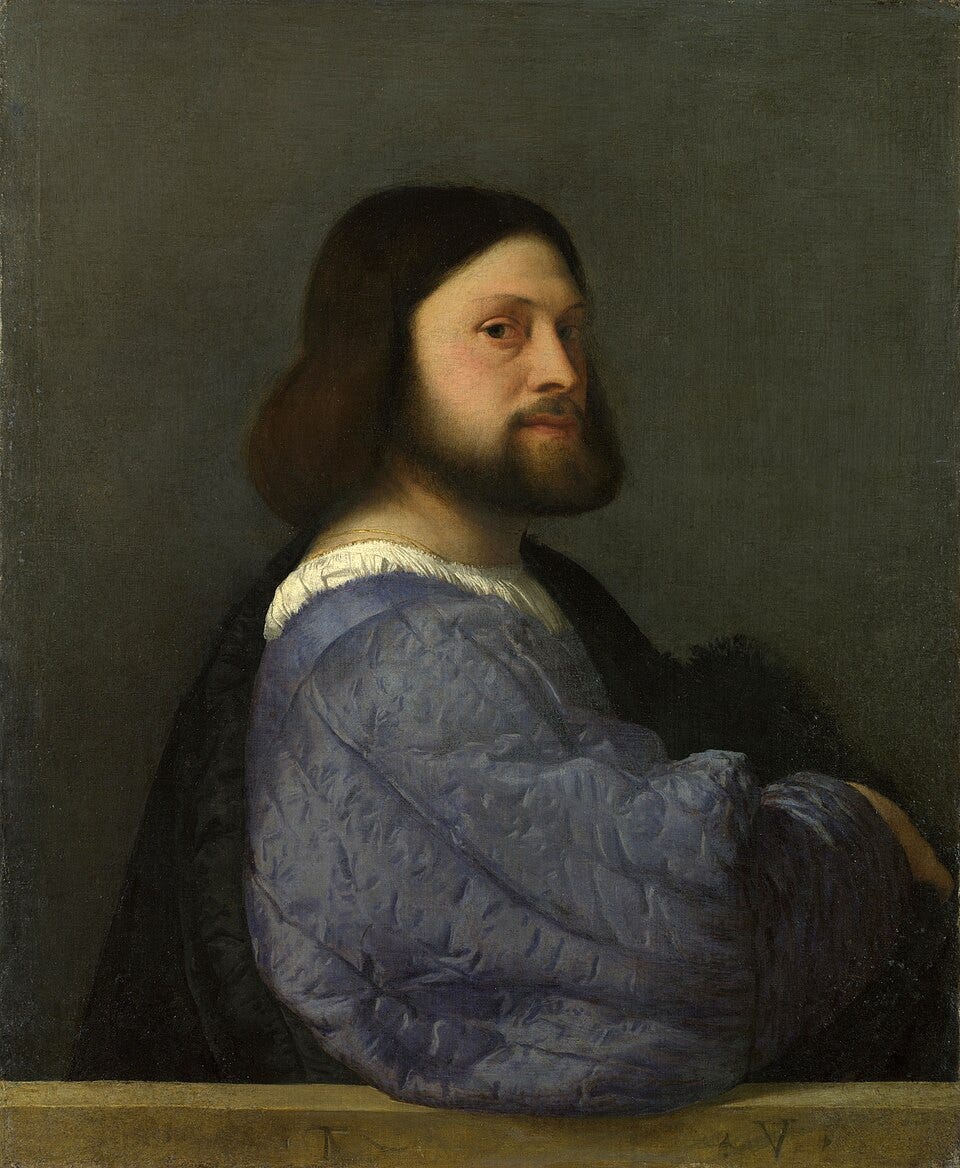
The conductor stepped onto the stage. A three-armed brass candelabrum preceded him. The candlelight accentuated the lines and lozenges upon his pale blue robe. A snow-white silk shirt shimmered beneath it at cuffs and collar.
His North English shoes struck the floorboards of the shop. The muffled sound united itself with the returning tick of the clocks. His shadow wandered along the wood-panelled wall, tracing the silhouette of a man of middling height — and came to rest upon the walnut casing of the longcase clock. Candlelight danced in the chased patterns of box clock lids upon the window ledge.
Lucius Horologius, the first and only clockmaker of Palatina, looked out upon the Piazza. Darkness had settled over the city an hour since. On the far side of the square, lights glowed in the upper storeys and illuminated the last carts and carriages that rattled over the cobblestones. The Taleggio cooperage opposite had already closed; apparently because Taleggio’s journeymen had once again hoodwinked their deaf master into believing that the cathedral bell tower had long since struck the hour. Whilst they raised their wine cups in the nearest tavern, the merchant Fontina was catching his assistant by the collar again and dragging him back into the corner shop. The pealing of bells signified for Fontina not the end of the working day, but was rather an unwelcome reminder that his subordinates were also obliged to eat and sleep — lest, given their already overstrained working efficiency, they should eventually collapse.
The clockmaker’s gaze wandered to his right. Beyond the square, the Rio, the great river, rolled its waters through the city. Torches at the sterns of gondolas bespoke the city’s wealthy élite, who were being rowed homeward — or towards their next diversion. The boats flitted across the black waters like fireflies. Behind them rose the pilasters of the Ponte dello Stagno — the Tin Bridge — upon which the fires of the forges and smithies flashed. Grey smoke billowed from the chimneys of dozens of houses crammed together upon the Gothic bridge arches. Quenching water hissed between the hammer blows of the smiths. Waste water ran through tin pipes as fountains into the river. The interlocking tenements of San Pietro loomed like monsters in silhouette against the distant sky.
One moment Lucius was still watching the activity upon the bridge. The farriers closing their establishments. The tool smiths who remained. Then the founders, already passing before the shop door. He thought of how this world had nothing in common with his perfectly calibrated clocks, which struck each evening in unison at the precise moment. He thought of how this was the hour for which thousands of Palatines had been waiting.
And he thought that he was perhaps the only person in this city who begrudged the close of the working day.
The next moment, the window reflected only the clockmaker himself. He looked into his own grey-blue eyes. Candelabrum light fell upon his neatly trimmed, light brown beard. Mid-length hair and a black cap framed his face. It was the face of a man in his mid-thirties who had come to Italy with great expectations — and now stood before great difficulties.
Palatina had fifty thousand inhabitants. The city was accounted one of the wealthiest in central Italy. His shop stood on the principal thoroughfare of the city. Lucius had wondered that he should be not merely the only, but the very first clockmaker in the history of this city.
After a month, he knew better. Every clockmaker was fated to despair of Palatina. There was not a single public clock in existence. Each district insisted upon the bell strokes of its own campanile. Which meant, in practice, that San Paolo rang its bells earlier than San Pietro or the Città Nuova, in order to be ahead of its neighbours. Taleggio’s journeymen did everything in their power to prevent their master from being able to read the time anywhere. The smiths did not conclude their day’s labour at seven o’clock in the evening, but rather “around” seven. This was more than ignorance. It was a way of life. Germans and Italians alike built the finest clocks in Europe — Lucius knew this well enough. Yet it was chiefly the Germans who actually made use of them.
In his native York, the Horologius clockmaker’s shop had enjoyed a reputation extending well beyond the region. Merchants from London and gentry from the provinces had made the journey on his account. Yet since his removal to Palatina, he had not sold so much as a single table clock. Neither had his new clock model, with its melodious bird-shrieking, proved persuasive to any customer. The only customer who had come in had been so thoroughly startled by its striking that she had fled the shop in a panic.
The clockmaker stroked his beard. Perhaps the device could still be converted into a serviceable alarm.
Then he breathed deeply. Lucius had waited long enough.
Keys clinked against the metal of the candelabrum. His hand slid towards the brass clock face that formed the door knob — until a rapping interrupted the ticking. Gloved fingers knocked against glass.
And although the clockmaker, in contrast to the Palatine tendency towards dilatoriness, believed in firm English principles such as punctuality and adherence to rules, he hesitated only briefly before setting down the key and opening the shop door instead.
“We are closed.”
Lucius waited in the doorway. Upon the threshold stood a gentleman, more or less of an age with himself. Tall in stature. Slender. Beneath lightly curled hair, dark eyes rested — fixed upon the clockmaker.
“Forgive me. You are the Englishman?”
Lucius endeavoured to make out details. But the stranger stood half in darkness. His black garment concealed the rest.
“Horologius,” the clockmaker corrected — thereby making plain that he thought little of persons who did not address him by name, but instead presumed to give him one.
The stranger nodded. Lucius noticed a glinting at the man’s lapel.
“And you are …?”
The glinting proved to be a golden lily at the coat collar.
“Raffaele di Tesino. From the Città Antica.”
Lucius possessed the gift of not widening his eyes when a situation surprised him. He had lived too long in sober York for that. Instead, his ears lifted the very smallest degree, for this was the sort of customer he had long been waiting for.
The Città Antica was the seat of the wealthy and powerful. They resided in villas and palazzi upon the Palatine, the city’s principal hill. Whoever lived there could afford a clock — with golden cog wheels and an enamelled clock face.
“Well then, di Tesino,” Lucius began with studied composure, “would you not prefer to call tomorrow morning?”
“Tomorrow I have no time.”
“I am a clockmaker. I sell time.”
Raffaele smiled.
“Then you are precisely the man I am looking for. If I might step inside?”
Lucius remained wary. Much as he wished to win this customer — men of influence who appeared after closing time wearing black cloaks brought trouble with them. One need not have lived in Italy to know as much. Those who did not know such simple rules, after all, no longer lived at all.
The man from the Città Antica must have sensed the mistrust that was building between himself and the clockmaker, growing ever more impenetrable, until Lucius would bar his way entirely.
But Tesino brought the metaphysical wall crashing down before the clockmaker had been able to raise it.
“What would you say,” remarked Raffaele, as though in passing, “to repairing a clock for me that is worth a whole county?”
*
The candelabrum cleared a table, sweeping paper, drawings, and quill pens along with it. Not so much as a dust particle remained upon the wooden surface. With a crash, Lucius rammed the brass into the centre, so that drops of wax spattered across the beech-wood grain.
A chair scraped aside. Black fabric billowed through the air for a moment. The golden lily on Raffaele’s coat flashed.
“You keep flexible opening hours. I approve of that, Ser Horologius.”
In the background, the window shutters squeaked. Lucius let the bolt fall home.
“I should rather approve if you came to the point.”
The clockmaker’s shop resembled a Venetian fortress in a state of siege. Not even Ottoman cannon fire could have breached the small establishment on the Tin Square. Lucius had double-bolted the window. The door was shut. Every candle save the three on the candelabrum had been extinguished.
There remained only the flickering over the beechwood, Raffaele’s cool countenance, and the ticking of the clocks.
Then a new object entered the scene. Red gold gleamed before the candelabrum. The reflection dazzled the clockmaker so greatly that he was obliged to narrow his eyes. Lucius held his hand before his brow and ventured a cautious squinting glance towards the table.
A pocket watch swung to and fro on a chain. Raffaele allowed the clockmaker his time; Lucius’s head followed the oscillations, as though determined not to lose a single detail from sight.
“I have seen no such model, either in England or in Italy,” the clockmaker remarked. “What manner of clock is this?”
“A bespoke commission.”
“All pocket watches are. But a piece of this sort — of this size — could scarcely be afforded by anyone less than a prince.”
“You are good,” said Raffaele approvingly. “The clock belonged to my father. The Count of Tesino.”
Until this moment the clockmaker had had eyes only for the pocket watch. For its peculiarity lay in its size. In its form. In its ornamentation. In its melodious ticking, which fitted so harmoniously into his remaining collection as though it had always been part of it.
But it was dawning upon Lucius that the surname of the former owner could be no coincidence. Raffaele bore the same name, after all.
“You will forgive my ignorance — I am still new to Palatina,” the Englishman forestalled any objection, “but is this Tesino part of the Republic?”
Raffaele arrested the pendulum motion. He drew the watch back. Lucius noticed a flickering in the dark eyes of the Tesino, who waited for a moment.
Lucius knew that people reacted thus only when they had something to conceal.
“The valley of Tesino, from which my family originates, lies on the border between Trentino and the Republic of Venice,” Raffaele stated curtly. “Everything further is of no consequence whatsoever to this transaction.”
Lucius stroked his beard. He might take note of this and hold his peace. But there were inconsistencies pressing themselves forward that clung to this story. Such as the circumstance that the Trentino lay hundreds of miles distant. And that it appeared decidedly suspicious when an heir apparent should carry his father’s legacy with him so very far from home.
Palatina was a small state. But one that offered refuge in the turmoil of this new age. It was the epoch of the liberal arts. Of religious persecution. Of the Italian Wars. And all of them sought out this oasis in the desert of European madness.
Even Catholic York had not been able to hold out indefinitely against Protestant London. The English Reformation had closed the monasteries upon which the economy of his native city had depended. The end of Catholicism had signified the decline of York.
Lucius therefore understood only too well what Raffaele left unspoken.
“You are a refugee.”
“I prefer ‘exile with a fixed domicile and fair-weather prospects,’” Raffaele emphasised. “Not everyone who has been driven from his homeland can call a palace of seventy-two rooms his own in a foreign country.”
Lucius briefly calculated how many rooms his own house contained, and resolved thereafter to hold his peace.
“Come here,” the exile continued. “You have not yet seen anything.”
Lucius did not seat himself at the table when Raffaele set the watch upon it. He knelt before it and laid both arms upon the surface.
This portable timepiece was different. Lucius was acquainted with the elaborate pomander clocks that patricians wore suspended from a chain like thuribles. In his own stock he additionally carried the cylindrical box clocks. Both symbolised the progress of the Renaissance, in which one no longer needed to read the time from bell towers or town hall clocks, but instead carried time upon one’s person. The individual was no longer dependent upon his surroundings. He commanded time at will.
Even if time proved cumbersome in practice. The box clocks and pomander clocks were unwieldy. Their weight made itself felt after several hours. One set them upon a table at the first opportunity.
The Tesino watch differed from every other clock that Lucius had ever seen — and would ever see in the future. It was not even as large as a fist. Its form was oval, resembling a compressed cylinder, no more than a quarter the height of the box clocks he offered in the shop. The upper surface was dominated by a pattern of ornaments and lozenges reminiscent of a compass rose.
On the underside, a lily flashed in the candlelight. The engraving was precisely the same as that which Raffaele wore at his lapel.
“You will permit me?”
Raffaele had not yet answered when Lucius pushed himself back from the table and wrenched open the drawer of a wall cupboard. A magnifying glass glinted from the far side of the room, accompanied by a pair of tweezers. With a tender touch, the clockmaker clipped the masterpiece open.
“Southern German work.”
Lucius clicked his tongue as he did so. Through the glass, he examined the hour hand, which rested above a flickering brass sun. No fewer than two rings completed the clock face, one bearing Arabic numerals, one Roman. The twelve signs of the Zodiac occupied the space beneath them in miniature.
“Nuremberg, most probably,” said Lucius after a pause. “These ideas are characteristic of the Nuremberg ingenuity. Yet the artistry of the clock face might point to an Italian provenance.”
The client nodded with satisfaction. Lucius was telling him what Raffaele already knew.
“You know your craft.”
“My father studied under Peter Henlein.”
Raffaele started.
“The master of masters?”
“Is there another Peter Henlein?”
Lucius allowed himself a broad grin. He had removed the glass from his eye and regarded the client with a winning expression. This statement was Lucius’s calling card.
By this point at the latest, Raffaele found himself confirmed in his judgement. Henlein was not merely any clockmaker. He was the clockmaker. Henlein had not built pocket watches — he had invented the pocket watch.
And Lucius Horologius was therefore the perfect man for this task. Perhaps the only man.
A faint, metallic sound roused the exile from his dreams of hope.
“What is that?”
The clockmaker tapped the tweezers against a rectangular field beneath the noon position. Within it rested another numeral. Lucius pressed his precision instrument against it and detected a rotating mechanism.
“A date display. Ingenious.”
The Horologius stood open-mouthed — not in disbelief, but from the sensation of a childlike joy that some master craftsman had succeeded in incorporating a daily rhythm alongside the hourly one. Many had failed in the attempt to attach a minute hand, for the bodily movements and jolts of the daily perambulation gave rise to inaccuracies. But to insert a change of day every twenty-four hours — no one had hit upon that before!
The clockmaker jerked his head upward and looked towards the Tesino.
“What else did your father know about this clock?”
Impatience lay in his voice. Raffaele breathed out audibly.
“Even if I wished to — I could no longer ask him.”
“A family dispute?” Lucius surmised.
“Execution by Austrian occupying forces,” Raffaele corrected, with a smile that passed into a baring of teeth.
Lucius lowered his head.
“My condolences.”
“His death was ten years ago to the day. Do not trouble yourself.”
“And in ten years you have had the watch placed before no master craftsman?”
“I found it only a few months ago amongst his estate. Unfortunately Palatina had no clockmaker who might have been able to repair it.”
Raffaele tapped the clock face.
“Can you set it going again?”
Lucius tapped the hour hand with the tweezers. Although it was long since evening, and Raffaele had entered the room shortly after seven, the clock was still showing two o’clock. And yet from within came a melodious ticking.
“Strange, that. The clock has undoubtedly stopped …”
“… and yet the ticking still sounds,” Raffaele completed. “It is a mystery.”
The clockmaker lifted the masterpiece, held it to his right ear as though to assure himself that in the concert of table, longcase, and pocket clocks he was not confusing the sound with that of another device. But the warm sound of the Tesino watch was unmistakeable. He would have known it amongst a thousand — though he had been acquainted with it for only a few minutes.
It was a warm, pleasant ticking. One that flattered the ear. Not so deep that it lay upon one’s hearing like a bass note. Nor so bright that it set one’s nerves on edge after too long a time. Instead: pure melody. A lilting song. A lay.
“Ser Horologius?”
Lucius was obliged to set the Tesino watch down so as not to lose himself in its harmonics. Raffaele looked displeased.
“Allora,” he began. “How long do you think the repair will take you?”
“A fortnight.”
“I give you one week.”
Raffaele was a nobleman. One was obliged to display certain affectations and particular requirements, lest the craftsmen forget with whom they were dealing. At any rate, that was how Lucius interpreted the imperious behaviour.
“The festival week is at the door. I hardly think I shall manage to complete your commission amidst all the commotion.”
“Then you will work during the festival week.”
“On New Year’s Eve, not even the members of the assassins’ guild work.”
Lucius was a craftsman. One must always point out that one could never complete anything within the stated time, lest the customers forget how fortunate they were to be negotiating with the only master of his trade. At any rate, that was how the nobleman interpreted the dismissive behaviour.
“But you said you sold time.”
A purse struck the table. Before Lucius had understood what was happening, coins spilled from its opening and rolled against the Tesino watch.
“I should like to purchase some,” Raffaele continued. “The whole stock you have remaining, preferably.”
The clockmaker looked into the demanding eyes of the customer. Then at the lire and ducats glinting in the candlelight. Silver ermines tumbled amongst the scattered golden portraits of the Doges of Palatina. Three years’ wages of an ordinary working man covered the table top of the Horologius.
Raffaele thought he could purchase him. But Lucius had no need of money. What mattered more was what he desired. In this moment, that was neither dead Doges nor lire coins bearing the ermine motif — but the ticking of that watch, which called out to him.
“Agreed. You are fortunate that I am a clockmaker, and not an assassin.”
The Englishman extended his hand to the Tesino in a friendly manner. Raffaele smiled in the manner of someone acknowledging a poor joke but nonetheless showing amusement, not wishing to abandon a transaction still in progress. With an air of studied cordiality he returned the question:
“Because you are working overtime for me?”
“No,” answered Lucius with a cunning look, “but because otherwise I should have to kill you.”
The smile froze upon Raffaele’s face, and he swallowed it down. The clockmaker was not looking at him, but stared as though hypnotised at the Tesino watch, whose compass rose motif glinted in his eyes.
“This clock is worth committing murder for.”
Thank you for your valuable time. Mr. Italo is and remains free for everyone to read. Join the Lion Order of San Marco and subscribe! Roar like a lion and share this post!